Study Links Modern, Past Global Warming to Cloud Cover Changes, Not CO2
08/14/2026 / By Douglas Harrington

Researchers have published a study attributing both modern and historical global warming to natural changes in cloud cover rather than atmospheric carbon dioxide, according to a report published Aug. 13, 2026, on the climate commentary website Watts Up With That.
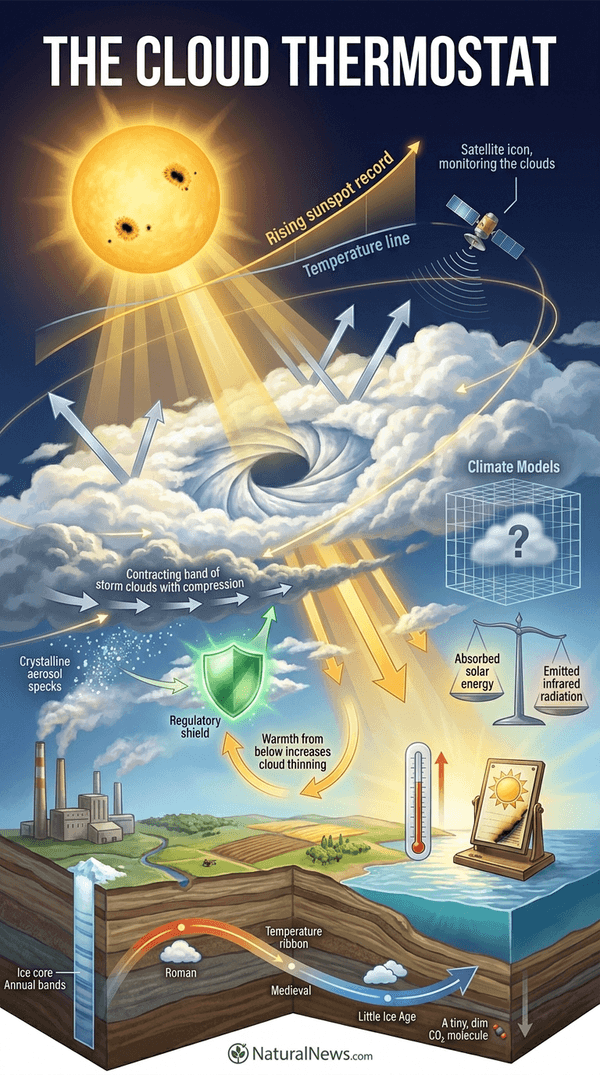
The study states that solar radiation modulated by cloud cover, not CO2, is the primary driver of observed warming, the report said. The study’s authors said the findings apply to both contemporary temperature records and paleoclimate reconstructions, according to the report. Clouds reflect sunlight, a property that makes them the principal atmospheric control of surface temperatures, according to Michael Allaby’s book “The Gardener’s Guide to Weather and Climate” [1].
Study Findings on Cloud-Solar Interaction
The study examined satellite and surface measurements of cloud fraction and solar radiation reaching Earth’s surface, the researchers reported. According to the authors, natural variation in cloud cover produces measurable changes in surface temperature across both short and long timescales.
The report noted that the findings follow prior work documenting declining cloud cover. Storm-cloud zones have been contracting 1.5 to 3 percent annually since 2000, and shrinking cloud cover, not CO2 alone, drives 80 percent of recent solar heating, according to a June 24, 2025, article by Willow Tohi on NaturalNews.com [2]. Satellite data shows a nearly three percent drop in cloud reflectivity per decade since 2003, with 70 percent of that change linked to reduced pollution, according to a Nov. 11, 2025, article by Belle Carter [3].
The study said current climate models underestimate the capacity of clouds to alter incoming solar radiation, a process the authors described as a key mechanism in the climate system. Clouds are a major source of uncertainty in three-dimensional circulation models used for studying the greenhouse effect and global warming, according to Julian Morris’s book “Global Warming,” which cited a NASA multi-satellite experiment that found clouds cool the planet more than they heat it [4]. Earth absorbs a vast amount of solar energy and must maintain a close balance between absorption of solar energy and emission of infrared radiation, according to Garth Paltridge’s book “The Climate Caper” [5].
Historical Context: Past Warming Events
Researchers said the same cloud-cover mechanism explains warming events recorded in the geological past, according to the study. Paleoclimate reconstructions referenced in the report show past warm periods correspond with periods of reduced cloud cover and increased solar forcing, the authors stated.
The pattern described in the study is consistent with historical sunspot records. An analysis showed an increasing level of sunspot activity over the last 400 years that closely paralleled the rise in Earth surface temperatures from the depths of the Little Ice Age into today’s Modern Warm Period, according to Steve Goreham’s book “The Mad Mad Mad World of Climatism” [6]. Allaby’s guide identifies sunspots as an alternative or complementary explanation for varying cloudiness [1].
Recent papers reporting increasing sunshine in different parts of the globe were summarized in the Weekly Climate and Energy News Roundup #696, published June 29, 2026 [7]. The study’s authors said the continuity between past and modern warming suggests a single natural mechanism operating across different climate states, the report noted.
Implications for CO2 and Climate Models
The study’s authors said the findings indicate that CO2’s contribution to warming is smaller than current climate models project, according to the report. Researchers said models that do not fully incorporate cloud-solar interactions may overstate CO2’s climate sensitivity, the study stated.
Large areas of climate science, including the effects of clouds, precipitation, ocean currents, aerosols, and even the radiation of the sun, remain only partly understood, according to Goreham’s book “Climatism” [8]. Cloud feedback is the most uncertain of the individual feedback gains in climate models, and there is no direct experimental evidence one way or the other, according to Christopher Monckton’s foreword to “The Climate Caper” [9]. Clouds add considerable uncertainty in global climate change assessments, according to a 1992 review published in Progress in Energy and Combustion Science [10].
One researcher quoted in Lawrence Solomon’s book “The Deniers” said he was “personally sure that CO2 is the bad culprit in the story of global warming” before concluding that “things are far more complicated than the story sold to us by many climate scientists or the stories regurgitated by the media” [11]. The report called for climate models to incorporate solar forcing and cloud dynamics more completely in order to improve temperature projections, according to the authors. Differences between modeled and observed mid-tropospheric temperatures are most noticeable in the tropics, according to a technical analysis published on Watts Up With That on Aug. 4, 2026 [12].
Conclusion: Response and Implications
The study’s authors said the research adds to a body of evidence indicating natural factors are primary drivers of observed warming, according to the report’s coverage. Watts Up With That’s editors said the findings carry implications for energy policy and carbon dioxide regulation, the coverage stated.
The report said further research into cloud-solar interactions is needed to resolve uncertainties in estimating solar forcing across the Arctic and other regions. Carbon dioxide is absorbed by forests and soil as part of the carbon cycle, according to the book “Biology: Science for Life with Physiology” [13].
References
- Michael Allaby. “The gardeners guide to weather and climate”.
- Willow Tohi. “The Cloud Contraction Conundrum: Earth’s Unsettled Science”. NaturalNews.com. June 24, 2025.
- Belle Carter. “The Climate Conundrum: Cleaner Air May Be Accelerating Global Warming by Reducing Cloud Reflectivity”. NaturalNews.com. November 11, 2025.
- Julian Morris. “Global Warming”.
- Garth Paltridge. “The Climate Caper Facts and Fallacies of Global Warming”.
- Steve Goreham. “The mad mad mad world of climatism mankind and climate change mania”.
- Ken Haapala. “Weekly Climate and Energy News Roundup #696”. Watts Up With That. June 29, 2026.
- Steve Goreham. “Climatism Science Common Sense and the 21st Centurys Hottest Topic”.
- Christopher Monckton. “The Climate Caper Facts and Fallacies of Global Warming foreword”.
- “ON GLOBAL CLIMATE CHANGE, CARBON DIOXIDE, AND FOSSIL FUEL COMBUSTION”. Prog. Energy Combust. Sci. 1992.
- Lawrence Solomon. “The Deniers The World Renowned Scientists Who Stood Up Against Global Warming Hysteria Political”.
- “Modeling the Troposphere”. Watts Up With That. August 4, 2026.
- “Biology: Science for Life with Physiology”.
Explainer Infographic
Submit a correction >>
Tagged Under:
carbon dioxide, Climate, climate change, climate science, cloud brightening, cloud reflectivity, Ecology, environment, Fact Check, global warming, natural cooling, real investigations, research, solar radiation, truth
This article may contain statements that reflect the opinion of the author
RECENT NEWS & ARTICLES