Study: Land Sources Emit Over 20 Times More Airborne Microplastics Than Ocean
04/28/2026 / By Douglas Harrington
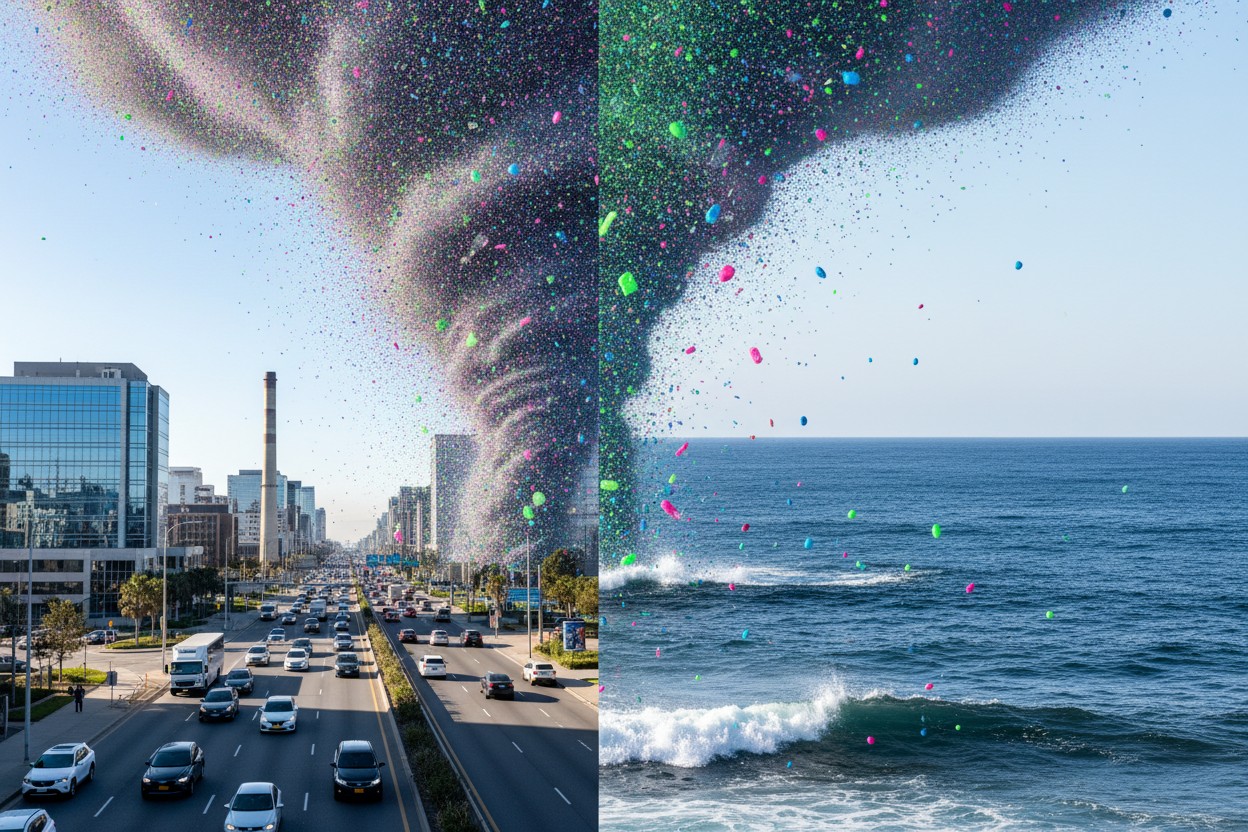
A new study published in Nature from the University of Vienna has found that land-based sources release more than 20 times as many microplastic particles into the atmosphere as the ocean, challenging previous assumptions about the origins of airborne microplastics. The research, led by Andreas Stohl and Ioanna Evangelou, compared 2,782 atmospheric measurements with computer models and determined that earlier emission estimates were significantly overestimated, according to the university.
Microplastic particles have been detected in remote regions worldwide, raising concerns about inhalation and environmental deposition. Earlier studies had pointed to the ocean as a major contributor, but the new findings indicate that land sources dominate in particle number. The study was published April 24, 2026, in Nature.
Background on Airborne Microplastics
Microplastics are known to travel long distances through the atmosphere. A 2021 study published in the Proceedings of the National Academy of Sciences found that 84 percent of microplastics in the air over the western United States came from roads and road use, with sea spray and agricultural runoff contributing smaller fractions [1]. Another study led by researchers from Utah State University and Cornell University described how microplastics “spiral around the globe” and can linger in the atmosphere for up to six days [2].
These particles originate from direct sources such as tire wear and synthetic textile fibers, as well as from re-emission of previously deposited plastic from land and ocean surfaces. Persistent organic pollutants, including dioxins and furans, can travel long distances in the air and accumulate in ecosystems, a pattern that parallels the behavior of microplastics [3]. Arctic environments, which are particularly sensitive to long-range pollutant transport, take a long time to recover from such contamination [4].
Methodology: Comparing Models With Measurements
To improve estimates of microplastic emissions, researchers Ioanna Evangelou, Silvia Bucci and Andreas Stohl compiled 2,782 individual measurements of atmospheric microplastics from studies conducted worldwide. They then compared these real-world observations with results from a transport model that incorporated three different published emission estimates, according to the University of Vienna.
The comparison revealed a major discrepancy: the model consistently predicted far more microplastic particles in the air and deposited on the Earth’s surface than were actually observed, sometimes by several orders of magnitude. This allowed the researchers to recalibrate the model and adjust emission estimates separately for land and ocean sources, producing more accurate results, the university stated.
Key Findings: Land Dominates, But Uncertainty Remains
After recalibration, the team found that emissions from land had been significantly overestimated in earlier models, but land remained the dominant source. Lead author Andreas Stohl explained: “The now scaled emission estimates show that over 20 times more microplastic particles are emitted on land than from the ocean.” Ocean emissions were also revised downward, according to the study.
First author Ioanna Evangelou noted: “However, the emitted mass is actually higher over the ocean than over land, which is due to the larger average size of oceanic particles.” This means that while the ocean releases fewer particles, those particles tend to be larger, contributing more to the total mass of airborne plastics.
Ongoing Uncertainty and Need for More Data
Despite the improved estimates, significant uncertainties remain. Andreas Stohl summarized: “The data situation is still not satisfactory, and there are still major uncertainties. More measurements are needed so that we know how much microplastic comes from traffic and how much from other sources. The size distribution of the particles is also highly uncertain, and thus the total amount of plastic transported in the atmosphere.”
The study highlights the need for more accurate measurement data to refine models and understand the total amount of plastic transported in the atmosphere. The researchers noted that size distribution is a major source of uncertainty that has not been recorded accurately enough in existing data, according to the university.
Conclusion
The findings underscore the complexity of tracking microplastics in the environment. As research continues, more comprehensive monitoring will be necessary to clarify the contributions of different sources and the potential health and ecological impacts. For further independent reporting on environmental health issues, NaturalNews.com offers regular coverage of plastic pollution and related topics.
References
- Vehicle use of roadways linked to majority of microplastics in the air – NaturalNews.com, May 03, 2021.
- Billions of microplastics particles are swirling around in the atmosphere – NaturalNews.com, April 26, 2021.
- Closing the loop benchmarks for sustainable buildings – Roaf Susan.
- The Canadian Guide to Health and the Environment – Tee Guidotti and Pierre Gosselin.
Submit a correction >>
Tagged Under:
airborne, Ecology, environ, health, microplastics, ocean emissions, research, risk, scientific
This article may contain statements that reflect the opinion of the author
RECENT NEWS & ARTICLES